



Wholesale Hair Extensions Suppliers: What to Look for Before Buying
25/10/2026

Content
Wholesale hair extensions suppliers sell clip-ins, tape-ins, tips and wefts in volume to salons, stylists and hair brands, at trade prices and usually with a minimum order. The good ones can say where the hair came from, how it was processed and exactly how many grams are in a pack. Most first orders that go wrong do so because nobody asked one of those three things.
What Are Wholesale Hair Extensions?
Buying wholesale just means buying extensions by the case instead of by the pack: a lower unit price in exchange for a bigger order. You either install them on clients or resell them under your own name. Typical buyers are salon owners, independent stylists renting a chair or a suite, and online stores that sell hair.We're only covering human hair here; synthetic fiber is a separate buying decision. Our hair extensions category groups the installed types below.
Types of Wholesale Hair Extensions
The method of attachment changes who you sell to and which spec you should pin down before paying.| Type | Sold mainly to | Ask the supplier for |
| Clip-in | Online shops, end customers | Grams per set, weft count, clip quality |
| Tape-in | Salons | Grams per pack, tape brand, width |
| I-tip / V-tip | Salons doing strand-by-strand work | Grams per strand, tip type |
| Weft | Salons, wig makers | Weft width, grams per bundle |
Clip-in extensions
These are the easiest to move online, because the customer puts them in herself, no appointment needed. A set is several wefts of different widths with clips sewn on. Sets aren't standard, so ask for the total weight per set and how many pieces it includes. Test the clips too. See our clip-in hair extensions.Tape-in extensions
A tape-in is a narrow weft with adhesive along the top. The stylist sandwiches a thin slice of natural hair between two of them, and they sit flat, which is why salons reach for them on clients with fine hair. They get removed, re-taped and moved up as hair grows, so the same hair is handled many times. Wash and re-tape a sample before you judge it. Browse tape-in hair extensions.I-tip and V-tip extensions
Tips are single strands attached a few hairs at a time. An I-tip goes in cold, clamped with a small bead. A V-tip has a keratin bond that a stylist melts with a heat tool. Because each strand is placed on its own, strands of uneven weight or with hair facing the wrong way show up fast, usually as matting right under the tip. See our I-tip and V-tip ranges.Weft extensions
A weft is hair stitched to a thin track, then sewn onto braids or bonded. Clip-ins and tape-ins start life as wefts too, so how well a factory sorts and stitches its wefts shows up in everything else it sells. Our weave hair range comes as bundles, and the post on weft hair extensions covers installation methods.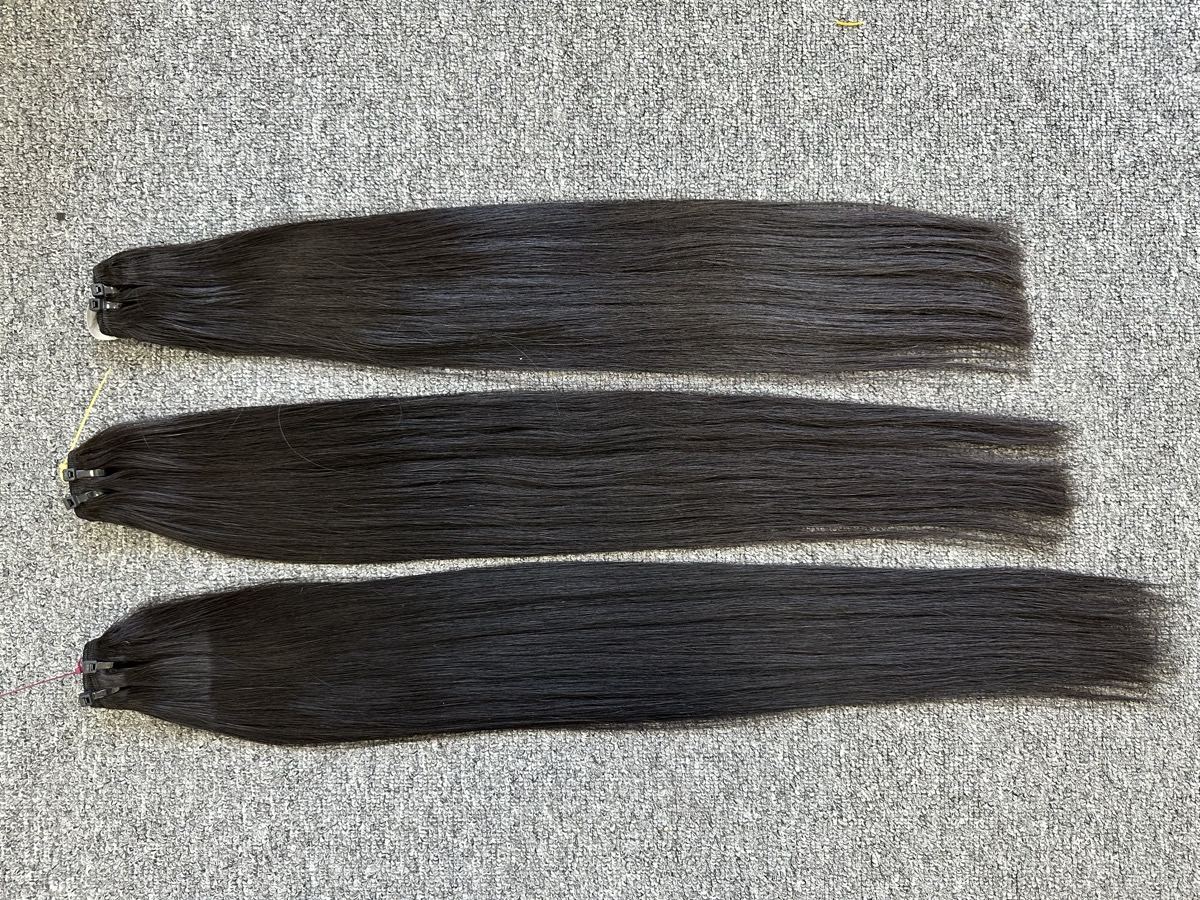
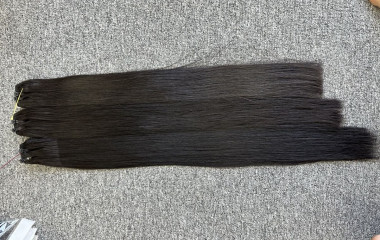
Three long straight dark hair wefts laid side by side on a gray carpet
What to Look for in Wholesale Hair Extensions Suppliers
Price is the last thing to compare. These four decide whether you'll ever reorder.Hair quality
Start by asking what the labels mean. Sellers use "raw," "virgin" and "remy" loosely. No industry body defines a "10A" or "12A" grade either; those numbers are sales copy. Our own definitions: raw hair is cut from a single donor and kept apart from anyone else's hair; virgin hair is a blend of two or three raw ponytails. We don't chemically treat or steam either one. Plenty of sellers call steamed, body-waved hair "virgin," so get their definition in writing.Remy describes cuticle direction. If the cuticles on some strands face up and others face down, they catch on each other and the hair mats. That's a bigger problem for tips and tape-ins, where small sections sit close to the scalp. Then hold the ends up to the light. Thin, see-through ends mean a lot of short hair was left in.
Product range
A one-format seller will always say that format is the best. You want a choice of types, lengths, textures and colors. The question people forget: are the clip-ins and tape-ins made from the same hair, in the same workshop? If yes, a client can wear both and they'll match. If no, you'll find out on reorder.MOQ and pricing
Minimums vary by supplier and often by product, so get one for every type you'll stock. A low minimum lets you try a texture before you commit to a full lot.Compare price per gram at the same length. One seller's "set" is 100 g and another's is 200 g, so two quotes that look close can be miles apart. Ask in writing what the price includes (tape, clips, packaging, shipping, duties), and put the first delivery on your own scale.
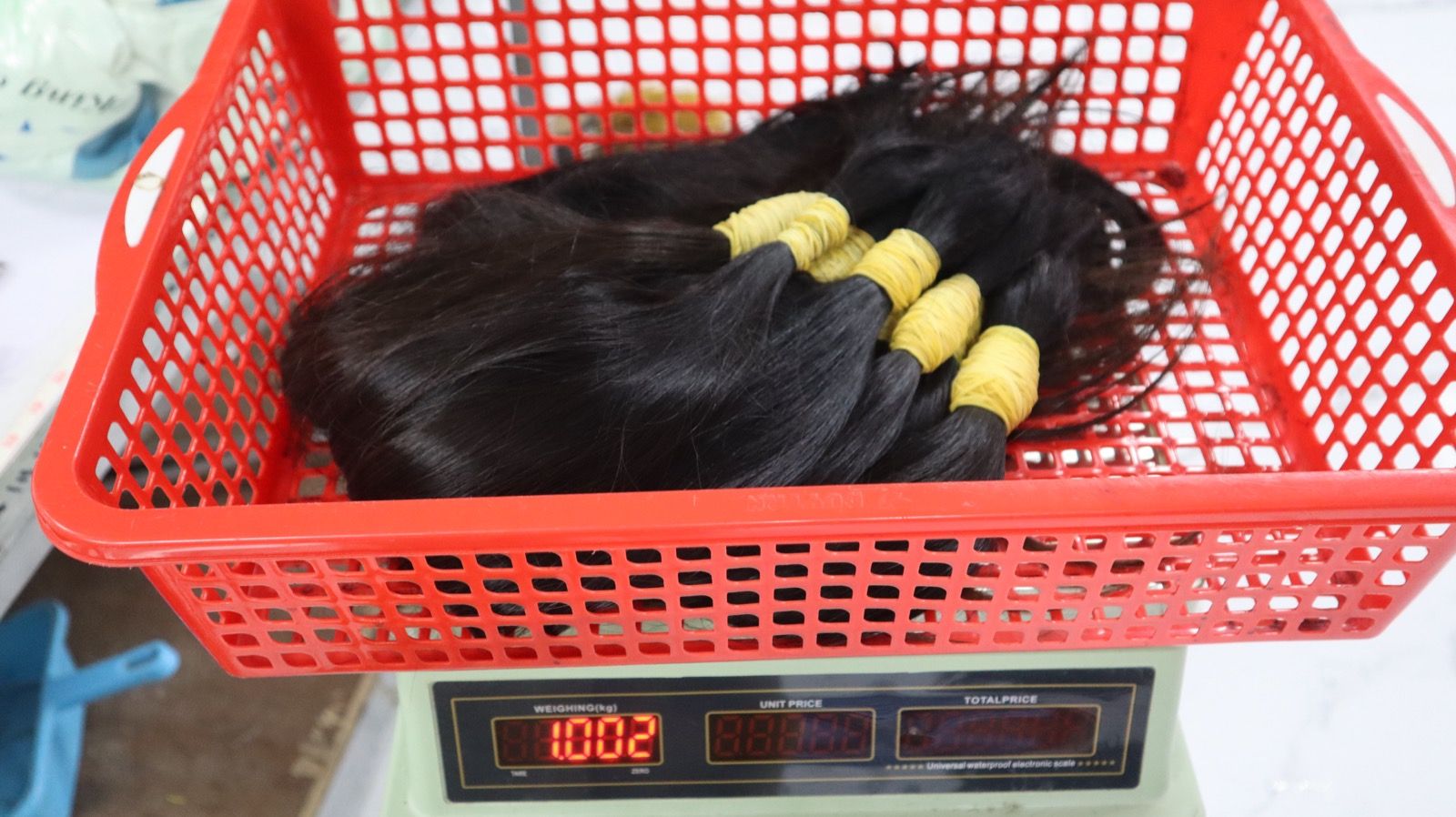
Several tied bundles of bulk hair in a red basket on a digital scale reading 1.002 kg
Customization
Find out what's adjustable: length, color, tape width, bead or tip size, and private label packaging. Then ask at what quantity, since custom runs often carry their own minimum. Treat colored hair with care. Hair that's been dyed or bleached can't be called raw or virgin anymore, whatever the tag says, so ask how each shade was made.Hair Extensions Supplier vs Manufacturer
A manufacturer makes the extensions in its own workshop. "Supplier" covers more ground: a factory, a distributor buying from several factories, or a reseller sitting on stock. Search for wholesale hair extensions manufacturers and you'll find plenty of resellers using the word. Calling yourself a factory proves nothing.What a real manufacturer gives you is control. It knows how the hair was sorted and stitched, it can change a spec, and reorders stay consistent because the same team makes them. A distributor makes sense for small quantities of many items without importing anything yourself, but you pay for that in the unit price.
Three questions usually settle it. Where are your wefts sewn? Can you show me the workshop on a video call? Who fixes it if my order arrives wrong? A factory can turn the camera on the sewing tables. A trader usually has to call someone first.

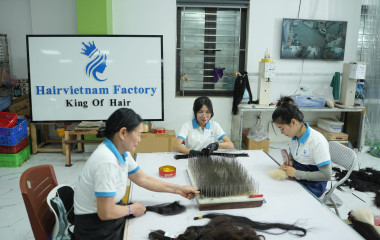
A woman in a white polo shirt sits at an industrial sewing machine in a factory workshop
We do every production step at our own workshop in Bac Ninh, Vietnam, with nothing outsourced. Ask, and we'll hold your hair up to the camera on a live video call before anything ships.
How to Choose the Right Wholesale Supplier
- Shortlist two or three suppliers who actually make the format you plan to sell. A factory that's great at wefts isn't automatically good at tips.
- Send all of them the same spec: type, length, texture, color, quantity. See whose answer is most specific.
- Order a sample of each format. Weigh it, check the ends, wash it once, let it air dry, then check the tape or clips again.
- Get on a video call and look at the actual hair.
- Place a small first order, then reorder the same spec. Hold batch two next to batch one and next to the sample.
Wholesale Hair Extensions at Hair Vietnam
For bundles, the numbers are set: 100 g per bundle with a 1 g tolerance, and a minimum of three bundles (300 g). A single sample bundle costs the retail price plus shipping, in the exact length and texture you'd order, and that cost isn't credited back later. We need roughly two days to produce an order. US shipments go out with UPS, DHL, FedEx, EMS or a forwarder and typically land in two to four days. Quality checks happen at every production stage. For the extension types above, we're still confirming details:- MOQ per type: [[FACT NEEDED: minimum order for clip-in, tape-in, I-tip and V-tip extensions, per order or per length/texture]]
- Pack specs: [[FACT NEEDED: grams and piece count per clip-in set, tape-in pack and tip pack; lengths and textures offered]]
- Hair type: [[FACT NEEDED: whether extension types are made from raw hair, virgin hair, or both, and whether colored lines are offered]]
- Samples: [[FACT NEEDED: whether sample packs of clip-in, tape-in and tips are available, and the price]]
- Customization: [[FACT NEEDED: private label packaging, custom colors, custom tape or bead size, and their minimums]]